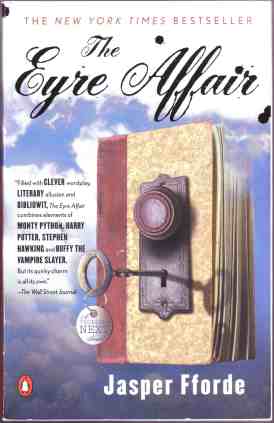
Set in a alternate earth circa mid 1980’s The Eyre Affair is one of the funnest rides i’ve been on in a while. Packed with whimsy (where characters have names like “Tuesday Next” and “Jack Schitt”), a unique twist on fantasy (the lines between reality and literature are so thin they can be inadvertently crossed), and zany sci-fi elements (entertainingly often introduced by Tuesday’s uncle Mycroft)
Fforde cranks out a book that is equal parts fantasy, sci-fi, mystery, drama, & comedy. He manages to pull it off in a way that doesn’t feel like a jumbled mess either, but rather comes off as an engaging and entertaining read! If you ever feel like you’ve lost the thread of what’s going on in The Eyre Affair just hang on Fforde will bring all the threads back together again in such a rewarding way!
Book Club of One grade: rock solid B+. My only regret is that i didn’t save this one for a vacation read, it’s such fun that it would be a perfect fit for consumption during some down-time (if i see a vacation this year that is haha)
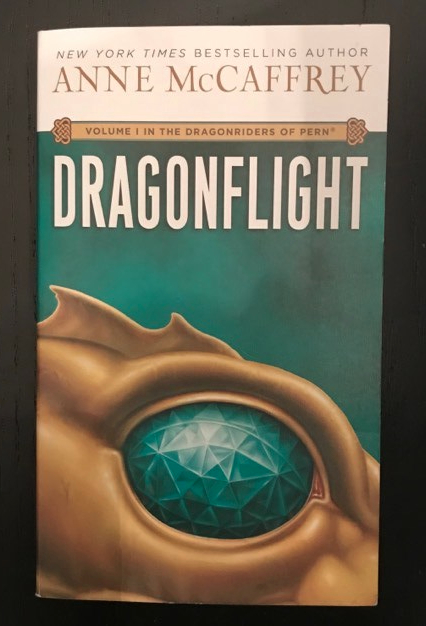
A pretty good romp overall! There’s a lot to like about Dragonflight for me. i had last read this book when i was a teenager… so nearly long enough for me to witness a second pass of the threads (which come in 200 year increments in the book… hyperbole, embrace it). There was so much i had forgotten, which made the re-read refreshing indeed.
Among the things i had forgotten: that Pern was founded by Earthlings in the future. Between being founded by a space-faring technologically advanced people and literally fliyng around on the backs of dragons in a feudalistic society Dragonflight is both Sci-Fi and Fantasy!
Characters feel solid and well developed. The spin that McCaffrey puts on dragons and dragon-kind is very interesting and really pulled me into the story. Telepathic and intelligent, with jewel-like compound eyes. They can still breathe fire like ye dragons of olde, but it requires them to chew “firestone” to do so. Most interesting (and plot significant) is the dragons’ ability to go “between” this allows them to teleport over long distances… and more!
If you’re looking for a fantasy that’s set in a very well-developed world, with interesting political caveats, developed characters, and a nice fresh spin on a fantasy staple (dragons) then pick up Dragonflight. Do keep in mind as you read that the pacing is pretty laid back throughout, up until the finale when things reach a crescendo!
Book Club of One Grade: B+ Once i adjusted to the slower pace of the book and just embraced it Dragonflight was a very enjoyable read overall, McCaffrey’s initial dive into the world of Pern gets a solid recommendation from me!
If reading is an amazing jet-craft of the imagination, allowing us to soar to new heights… then i’ve pulled the ejection lever on both of these series.
Let’s start with the nerd-blasphemy first: my inability to engage with The Thrawn Trilogy. i’m VERY well aware that so many Star Wars devotees sing it’s praises. This series is allegedly “The sequels we SHOULD have gotten”, but i’m glad we didn’t! My struggles with the series probably arise from my general distaste for fan-fictions, which the series feels so very much like. The writing seemed capably done, the story-line was moderate (as far as i got), and it is so very well received in general that i fully own it’s not you Thrawn Trilogy… it’s me! i’ll take my Star Wars on the big screen.
Then it’s The Book of New Sun, a series that Neil Gaiman has said very complementary things about. It is VERY skillfully written, the prose is absolutely beautiful throughout. The story-line sounds very engaging as well. So why is it that i constantly find myself in drone-mode reading pages without ever actually reading them? i’ll just be reading along and suddenly find myself completely lost narratively. One second we’re in the room of an inn with strangers and the next we’re crashing a cart into some sort of ruins! “Where is that large automobile, This is not my beautiful house, this is not my beautiful wife!!!” (shout out to the Talking Heads). i think, we just jumped to this spot but upon flipping back i find that it was all there, i just slipped into a trance and missed it all. This is not a problem i typically have with books.
In summary: Life is short. Life is uncertain. You shouldn’t waste life on bad food (unless it’s so bad it comes back around the horizon of badness and becomes good again, like a deep-fried Twinkie), bad beer, or frenemies! Also, know when to hold em, fold em, and when to walk away. i felt like it was my time to walk away from both of these series.
Book Club of One Grade: (inconclusive on both) i don’t want to grade something i haven’t fully engaged with. Give em a go for yourself (i hear the Thrawn Trilogy is amazing haha).
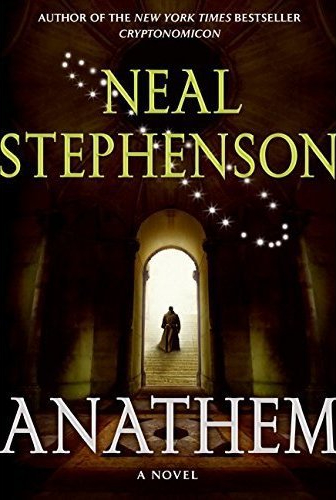
Anathem is a meaty sci-fi romp through a number of philosophical thought experiments. When i use the term “meaty” here i mean meaty like a primal cut of beef brisket: It’s large (this is quite a read), and dense (i’d guess close to 50% of the word-count of Anathem is dedicated to philosophical debates).
The Title “Anathem” is a mashing together of Anathema and Anthem and refers to a sort of ceremony of disgrace that takes place during the story.
Stephenson does a good job using a sci-fi setting that’s not Earth to make some great observations about life on Earth as we know it. Two of my favorite of these observations were the “Jeejaw” and “Slines”.
Jeejaws are the cell-phones of Stephenson’s world. The world is seperated into Avout and Saeculars. Avout are those pledged to a monastic tradition and committed to a minimalist lifestyle, most of the main characters are Avout. Saeculars represent basically everyone else in the world. The Avout live without Jeejaws and they find them to be intrusive and great distractions when they move out and interact with the Saecular world. It was just another nudge to help me see the intrusive impact my own cell-phone has made in my life.
Slines: Slines represent a sort of popular culture consumer in the Saecular world. If you’ve ever felt like an outsider to those enamored with popular culture you’ll likely find in the Slines a familiar sort of occurrence…
The story-line is pretty sweeping overall (but the book is certainly long enough to contain such an ambitious plot). You’ll travel from simple monastery life, through Anathem’s world-at-large, and eventually wind up in space with pan-dimensional beings… Things wrap up with a very jarring, and intriguing, exploration into the many worlds interpretation of quantum mechanics, with an interesting twist asking, “what if the many worlds have some sort of effect on each other?”.
Book Club of One grade: B+ Worth the read. Anathem is not light reading and sometimes it felt like the story-line was moving in fits and starts, you may spend many pages on a dinner chat then in two pages find yourself across a continent or into space itself. Overall the concepts it lays out, the social insights, and the refreshing story-line make it a fine piece of Sci-Fi.
i’ve noticed a trend of late when i have the privilege of sitting around a table to play some D&D with friends… nearly everyone plays A-hole characters!
“i’d like to make a slight of hand check to steal the gem he just found from him”
“He’s passed out? i take his pants off and drag him outside.”
“i’m not burning my last heal on you, you can make death-saves if you go down!”
Why does this seem to be such a trend around tables these days? What happened to playing a group of companions? To working as a team? To being fantasy-friends?
Back in the old days we had some jerkish characters, sure. There were jerkish thieves who stole from their party, but they tended to be the outliers. Now even the good aligned fighter seems to want to snag treasure from his companions. Is it a reflection of our change towards each other in general in the world? Is it a case of art imitating life? Are we all frustrated by being worked over by others so when it comes time to escape into a little fantasy we want to be the jerks coming out on top at the expense of others? i’m not sure, but it’s food for thought…
In the meantime, “Adventurer seeks trustworthy and friendly companions to embark on random quests with!”
The sweet sweet taste of speculative science fiction!
Let me open by saying there’s quite a bit i really liked about this book… and not a lot that i disliked (got ya!)
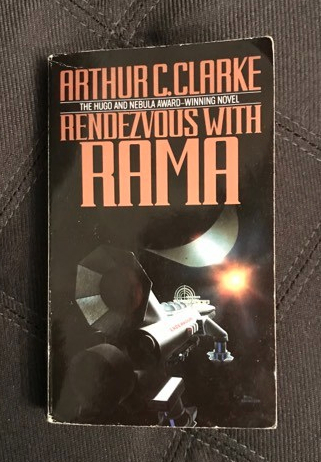
It really was a refreshing read for me: A Strange cylindrical object hurtles through our solar system. The closest space-ship makes an unplanned run for the object to see what it is and finds out it’s an alien spacecraft (cue orchestra hits here).
One of the things i most liked about Rendezvous with Rama was that it doesn’t spoon feed the reader explanations for everything the explorers find on the vessel. It’s packed with mystery the way raisin bran isn’t packed with raisins. When i finished the last page of the book it left me wondering what certain areas in the giant ship were really for, about the ecology of the place, about… well, about so very much!
i know that there is a whole series of Rama books that Clarke penned, and honestly i’m torn. Part of me wants to read them, i want to dig deeper into the mystery that is Rama with him. Yet, i also want to keep the curiosity alive and not plug it with explanations.
To pass judgement: Book Club of One grade: A. It’s fun, it’s thrilling and tense without dipping into horror. Rendezvous with Rama is a near perfect read for a long trip, by car, plane, or space craft!
Outlander… Steamier than the hot-bar at Golden Coral!
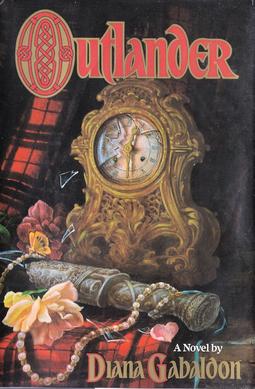
The tale of a post-WWII nurse who finds herself 200+ years back in time! Scottish highland shenanigans and political intrigue abound! Oh… and it’s a romance novel…
It’s my first dip into a real “romance novel”. Granted, i’ve read lots of books where romantic interests were front and center, even some books that if made into a movie would certainly fall into the category of “Chick-Flick” (spoiler: i LOVE a good chick flick! haha). “Real” romance novels use a lot of words like “Slippery”, and “Swollen”, and “Thrust”… There’s also the phrase, “He sheathed himself all the way to the base…” (that’s in there… double entendre intended)
Pardon me while i fan myself off! This is sexy stuff!
Also… it was super distracting for me. i’m all for healthy sexuality, heck i really enjoy healthy sexuality! But the constant jumps to sexy-time with steamy (granted creative) descriptors was just too much for me. Let me explain by not talking about The Sex: Epic battles are AMAZING, but if a novel spends too much time describing every sword-stroke and wound inflicted in flowery and creative language it eventually (by which i mean quickly) becomes a distraction to the story-line.
Outlander was pretty well written overall (even the gratuitous sexual encounters were written with some real skill). i really wanted to like Outlander. Characters with complex personal and political motivations. Strong(ish) female lead. Scotsmen!!! But alas it still never managed to grab me. Jamie felt like a perfect hero up until the end of the book. Claire was an engaging heroine, complex in her actions and reactions, but close to the end of the book she pulls a stint as a seer-level insightful immersive psychologist… that really killed it for me. There were hints at some cool fantasy elements that never really seemed to develop: a scene with a witch where something engaged with the lead character and a cameo by Nessie, but neither went anywhere and could have been removed without affecting the plot…
Outlander was also plagued by a villain with thin motivations. There was nothing likable about Captain Randall… An enemy with nothing likable is just not very engaging to me (even Satan himself knows how to party!).
After reading the first book i think i’m done with the series. If you want to read something that throbs, thrusts and swells but don’t want to check your brain at the door you can’t go wrong with Outlander… But if you’re looking for time travel fantasy that features a strong female lead go with Doomsday Book by Connie Willis.
Book Club of One grade: C-, see above if you’re wondering if you should read this. Written with skill but not my cup of steamy, sweaty, throbbing tea.
My year of reading in 2017 was (like most of my goals for 2018) a tad lack-luster… Normally i read 50+ books in a calendar year. 2017 i consumed a grand total of 32 books… i did spend quite a bit of reading time consuming RPG related materials, which i didn’t really add to my consumption totals.
Pity-party behind us, let’s look at my top 5 reads in 2017 (in no particular order, except for my #1 pick)
Small Gods -Terry Pratchett
Wasn’t a huge Pratchett fan before reading this gem. If you want to know more about Small Gods you can see my Book Club of One review here: Small Gods: Book Club of One Review
A History of the World in Six Glasses – Tom Standage
A walk through human civilization breaking it all down in eras of imbibement! Chock full of great information. It is a little sad that our era is best described as the Coka Cola era… Other eras being marked by beer, or wine, or whiskey…
The Handmaid’s Tale – Margaret Atwood
i read The Handmaid’s Tale way back when i was in High School and it was a jarring powerful book that stuck with me! My re-read was possibly even more jarring! So well written, a powerful message, and possibly even more timely now than when i first read it.
Frankenstein -Mary Shelley
So, i’d never read this rock solid classic until this year. What a book! Nothing at all like the portrayals of Frankenstein’s monster that Hollywood has given us for decades now. Read this classic gem!
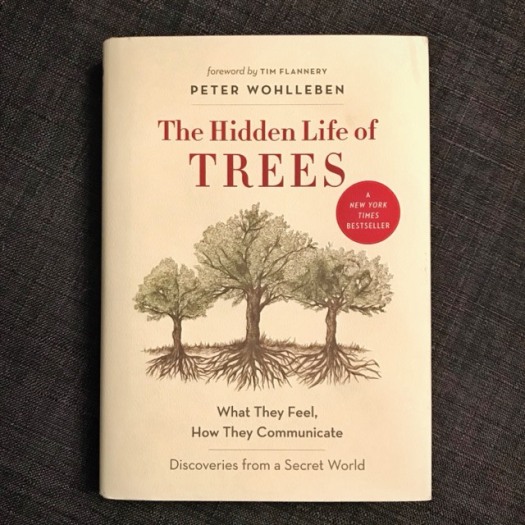
My #1 pick for 2017: The Hidden Life of Trees – Peter Wohlleben
Mind Blowing Reading!
i can’t think of any book that i’ve read recently that has challenged the way i view things more than The Hidden Life of Trees. Skillfully written, engaging, and packed with thought-provoking ideas. Read this book and never look at a tree the same again!
Well, there you go. My favorite reads from 2017 just in case you’re looking for something to feed your head, and your mind, and your brain (the holy triumvirate given to us by the great musician and philosopher Dewey Finn) maybe one of these will fit the bill!
Let me open this Book Club of One entry by redundantly hammering on a thing: This is a long book! One thing i’ve learned in this process is that us nerdy-folk must be drawn to thick books! If books were fast-food, sci-fi and fantasy books would be the Hardee’s/Carl’s JR’s Thick-Burgers of the book world! If novels were toast… they’d be the Texas Toast of the toast-verse! If these tales were toilet paper… they’d be triple-ply!
Observations about the average length of sci-fi/fantasy reads aside, let’s move on.
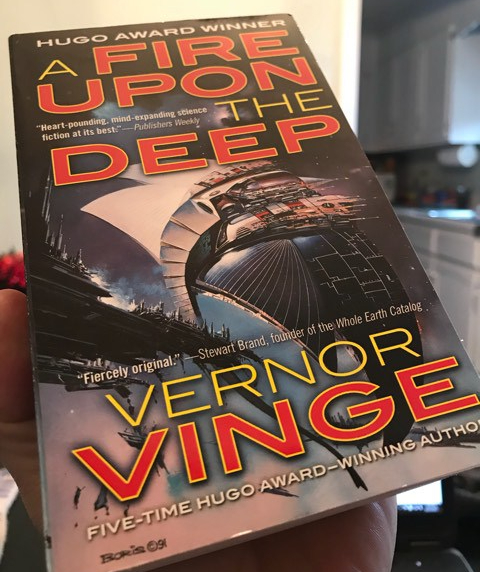
i really enjoyed A Fire Upon the Deep. While i never really got my head around Vinge’s “Zones” i liked the concepts of them. They made for some very interesting Sci-Fi reading.
Probably what i enjoyed most about A Fire Upon the Deep was the exploration into the idea of sentience. Vinge pokes at our notions of sentience without falling into the same tired tropes of many sci-fi novels. Sure, there’s a program that “becomes” sentient (or was it always a sentient presence and just needed the program to manifest itself) but it comes off as fresh. Partly because of the way he introduces and then develops it with the reader, partly because it is a new take on the idea. There are also some very interesting races. The Skroderiders are a tree-like folk who biologically lack short-term memories, but gain them by attaching themselves to mechanical motorized bases, called Skrodes – hence “Skrode-riders”. Because their natural memories are long-term based-only they bring a distinct world-view with them into the universe of the story. Another interesting race are the Tines. Tines are a sort of canine race but a single “person” consists of 4-8 individuals that are sort of telepathically linked to one another. Fewer than 4 and they are lacking in intelligence, greater than 8 and they become a sort of mob, too many conflicting minds to really form a properly functioning “person”. There are also transcendent beings, capable of manipulating physical matter as easily as we can manipulate our thoughts.
The story-line is enjoyable itself, nicely tying together medieval level action with super-advanced technological challenges! Children stranded on a low tech planet are thrust into low-tech political intrigue in their fights for survival while rescue streaks across the galaxy!
Mixed in like a dash of salt into chocolate chip cookies (if you don’t put a dash of salt into your cookies, you’re not doing cookies right) is a sort of space-internet known as “The Net”. The Net is limited by transmission bandwidth over the vastness of space. It’s full of “trolls” and half-truths (just like our current analogue in the real-world). Vinge’s frighteningly accurate portrayal of net-life is even more amazing when you consider that the book was published in 1992!
Book Club of One Grade: B+ (would be a super solid A but there’s a sort of Deux ex Machina thing that goes on). Solidly on the “read this” list for me. So good i bought a copy to put in my own personal library (which is being parred down with our down-size in dwelling, and it STILL made the cut). Not since Perdido Street Station has a setting of a book been so engaging to me!
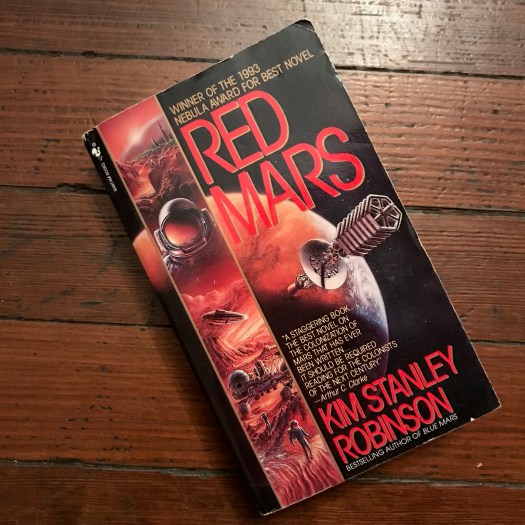
There’s been a long delay in entries from the Book Club of One. That’s because the BCoO has been powering through The Mars Trilogy!
Red Mars, Green Mars, and the conclusion Blue Mars.
The Mars Trilogy is a Sci-Fi tome about the colonization and terraforming of our red neighbor, Mars. Robinson writes a story that is worthy of words like: “Epic” and “Saga”. If you stack the mass market paperbacks together they come pretty close to making a cube of Science Fiction print.
Robinson does some very interesting things with his trilogy. He digs into lots of social, socio-economic, and governmental issues. i’ve mentioned before how much i like it when Sci-Fi is used well to help us see issues from a fresh angle, often helping us see past our own blind spots. The Mars Trilogy follows the tales of the “First 100” (the first one hundred settlers to Mars) and their immediate descendants (mostly).
Several interesting developments arise that lead us down some long but interesting rabbit trails. A near-cure for aging is formulated, bring up issues of what that looks like morally, socially, and economically. Is the treatment a human right? Is it a benefit for the wealthy? What happens to population control when people don’t die naturally? etc, etc, etc.
There’s the turmoil between those who want to terraform Mars and those who want it left in it’s natural state (“Greens” and “Reds”, who eventually are pressured by circumstance to reach some sort of compromise… “Blues” – spoilers haha).
There’s the task of establishing a whole new government, one unlike any on Earth. Which leads to some very interesting questions.
In the end Robinson brings things back around to the basics of human existence and our search for our place in the scheme of things, leaving us with a conclusion that is tied to the intimate connections between two characters. Two characters who have been with us for the entire trilogy.
My best descriptor of the series is that it is a platform for some pretty ambitious thought experiments.
The Mars Trilogy wasn’t one of my favorite reads of this project so far, which is a real shame. “Aurora”, a newer book by Robinson (published in 2015) is one of my top reads from the past 5 years or so. If you’re looking for something by Kim Stanley Robinson i’d recommend Aurora instead, same style: still using Sci-Fi to ask big questions and think through their ramifications. Aurora is not nearly as daunting as The Mars Trilogy though.
Book Club of One Grade: C- The writing is rock solid, the series is very thorough and in-depth… but for me that may be what kept its BCoO grade lower. If you’re the kind of person who wants that daunting epic read over the summer this could be the very thing you’re looking for. If you’re like me and after some time the large cast of players and the depth become a little overwhelming, well… did i mention that Aurora is one of the best books i’ve ever read?
 Grasshopperking(0)